Launch offer — valid today only

📄 Digital book in PDF · read it on your phone or print it

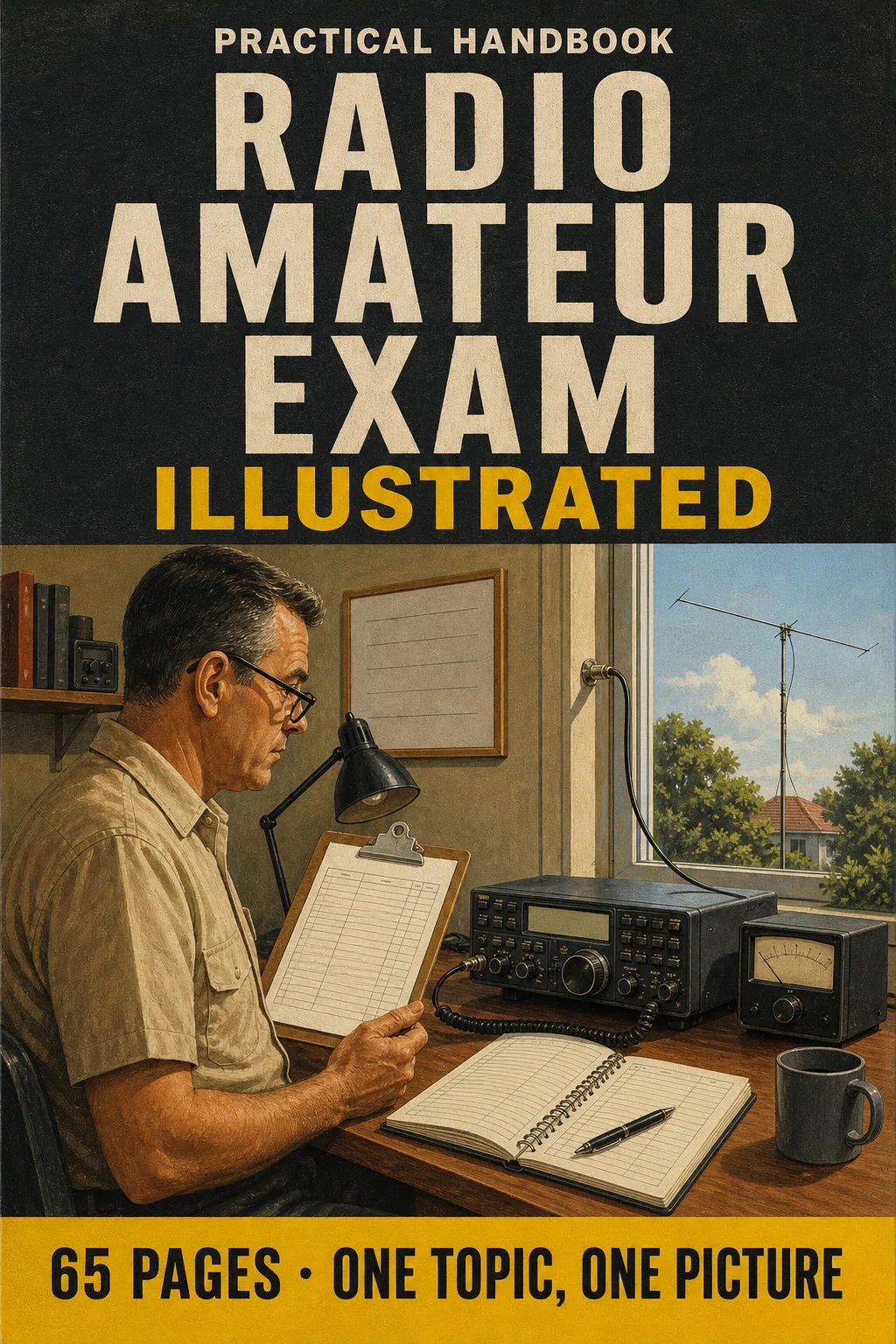
The Radio Amateur Exam and Class A Licence in Drawings One Topic per Page, Still There the Next Morning

The band plan, calling CQ, Ohm's law, decibels, resonance, the superhet receiver, the half-wave dipole, SWR and the skip zone. Each topic has its own page: the drawing first, then what you need to remember. 65 illustrated pages.

START STUDYING THIS WAY

🔒 Secure checkout · PDF by email · 30-day guarantee

Every topic, its own pageEvery rule, circuit and sum drawn, with the explanation beside it
65 illustrated pages8 parts, from the licence and the exam to exam-day revision
Up-to-date sourcesThe RAE syllabus, ICASA licence conditions and the Region 1 band plan
PDF by emailFormat

Look Inside the Book

Every page has one big drawing and a box with the numbers, rules or steps you need to know:

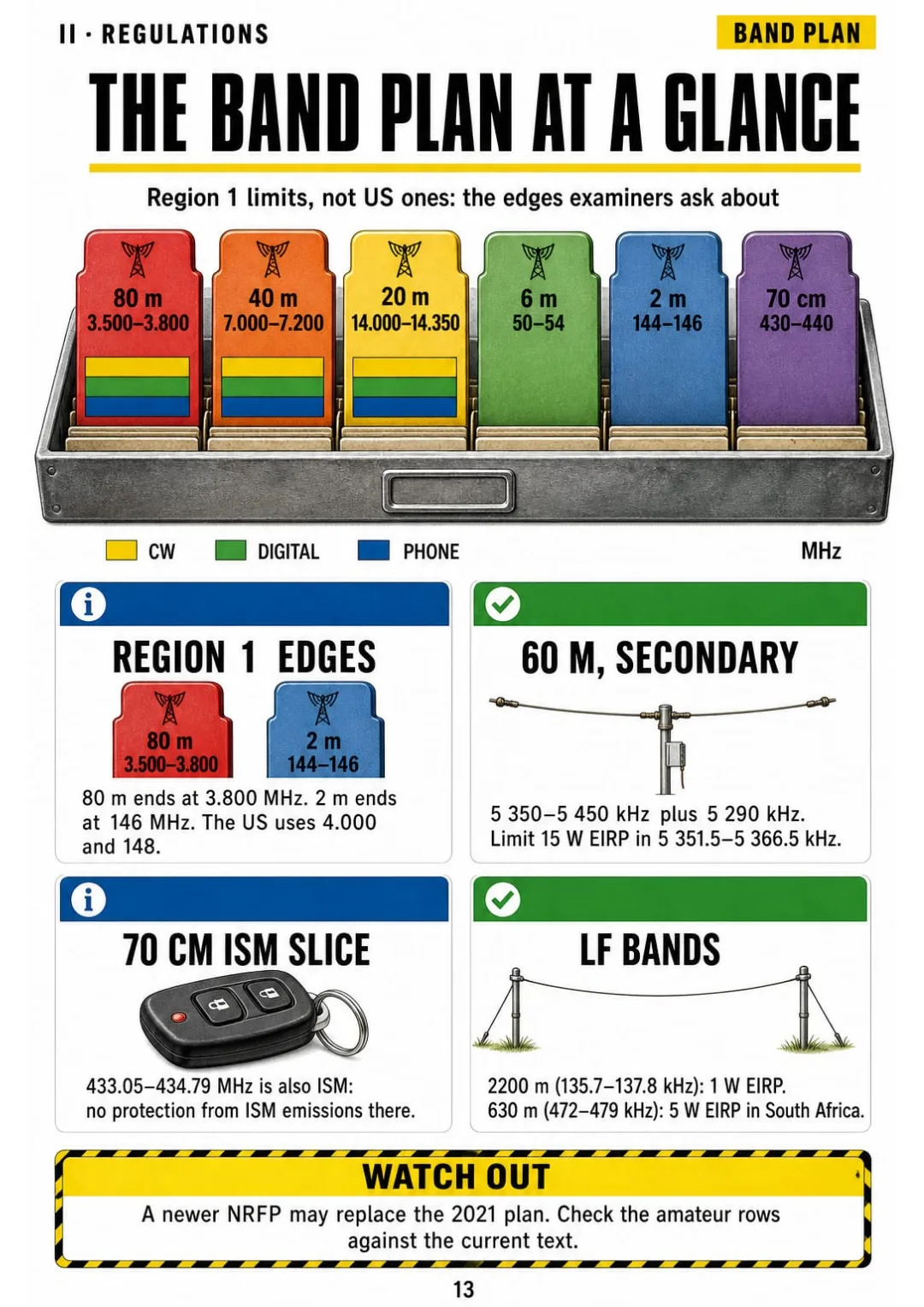
80 m 3.500–3.800 · 40 m 7.000–7.200 · 20 m 14.000–14.350 · 2 m 144–146 · 70 cm 430–440 MHz.
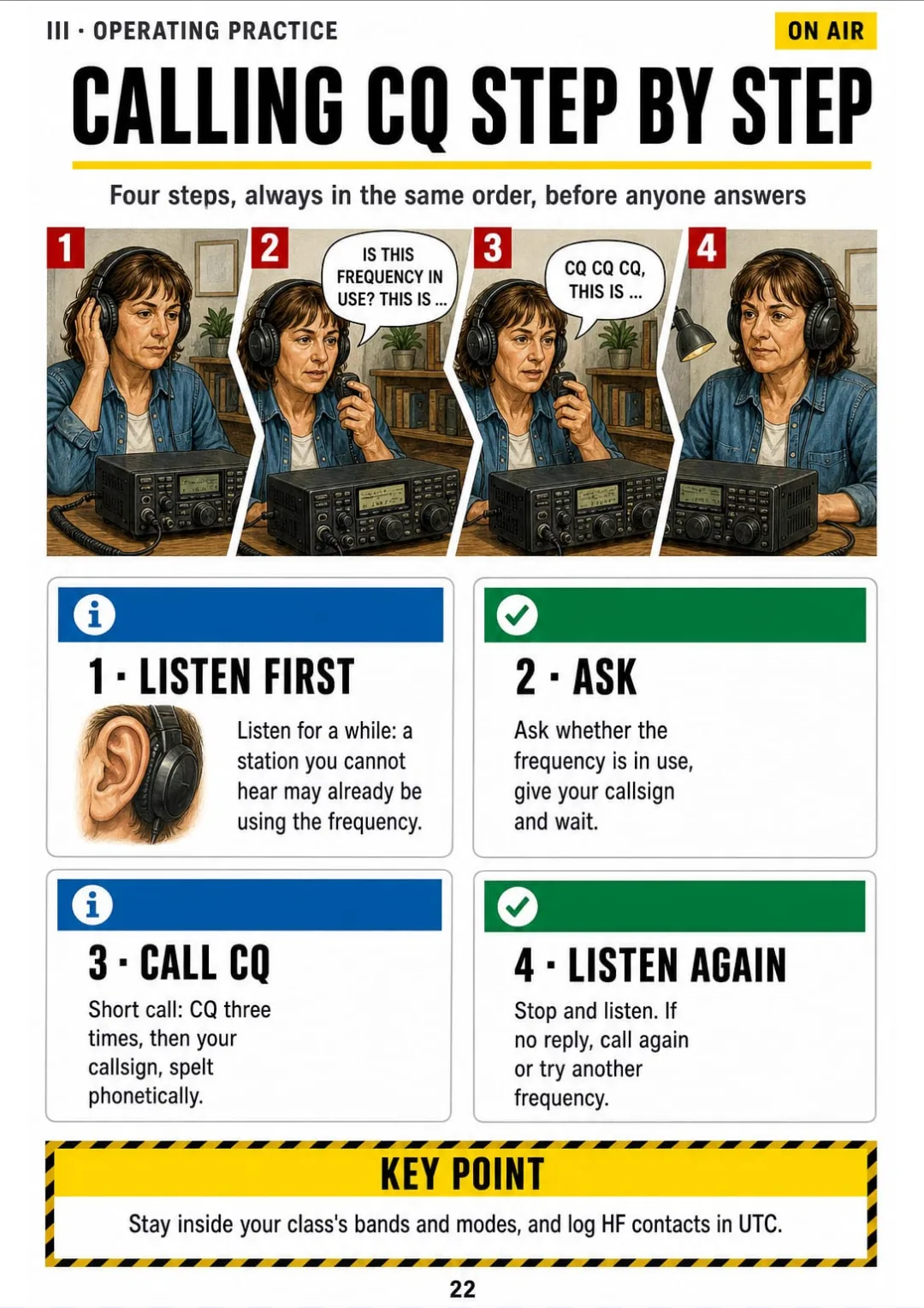
Calling CQ: listen, ask if the frequency is in use, call, listen again
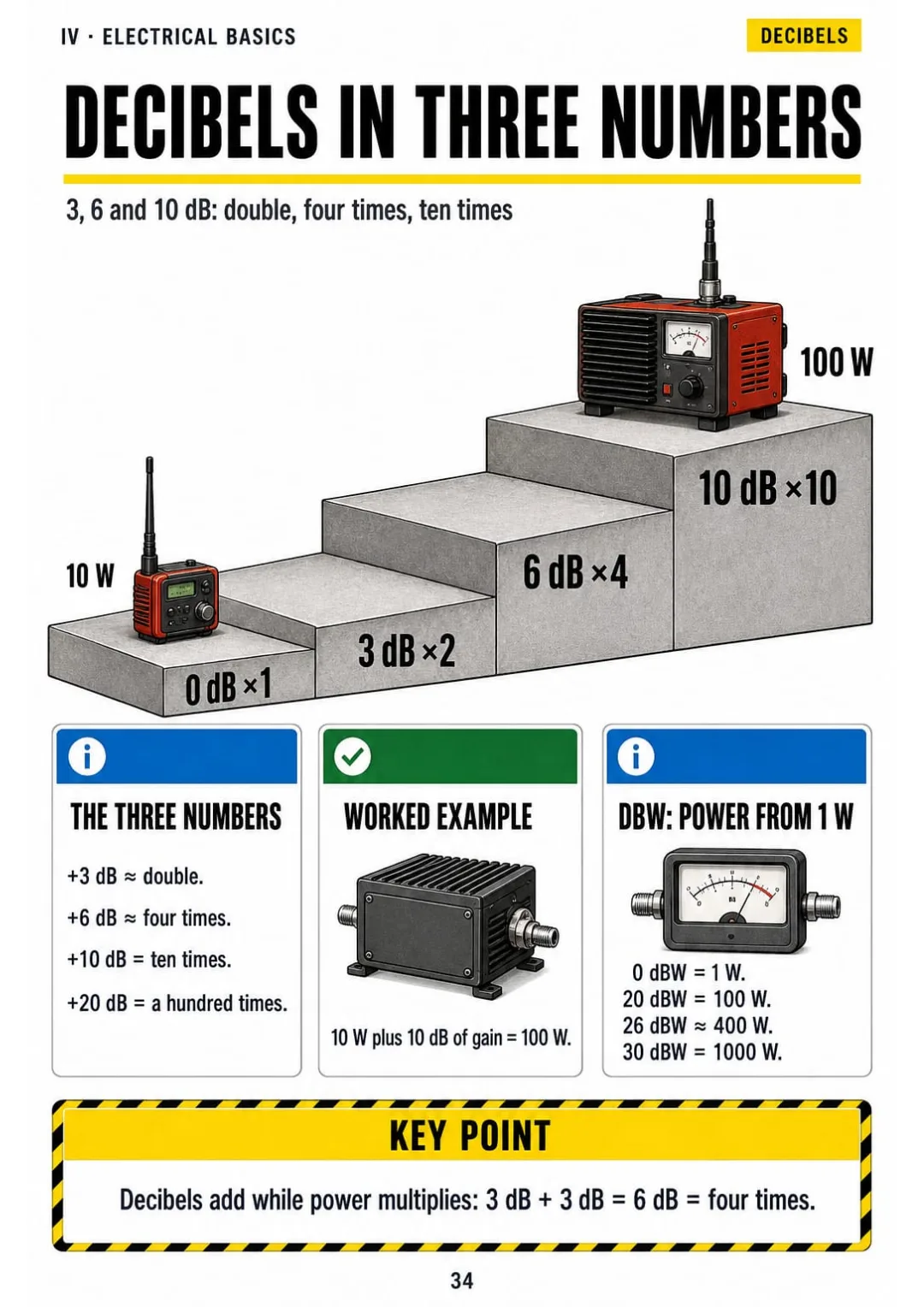
10 W + 10 dB = 100 W; 3 dB doubles, 6 dB quadruples.
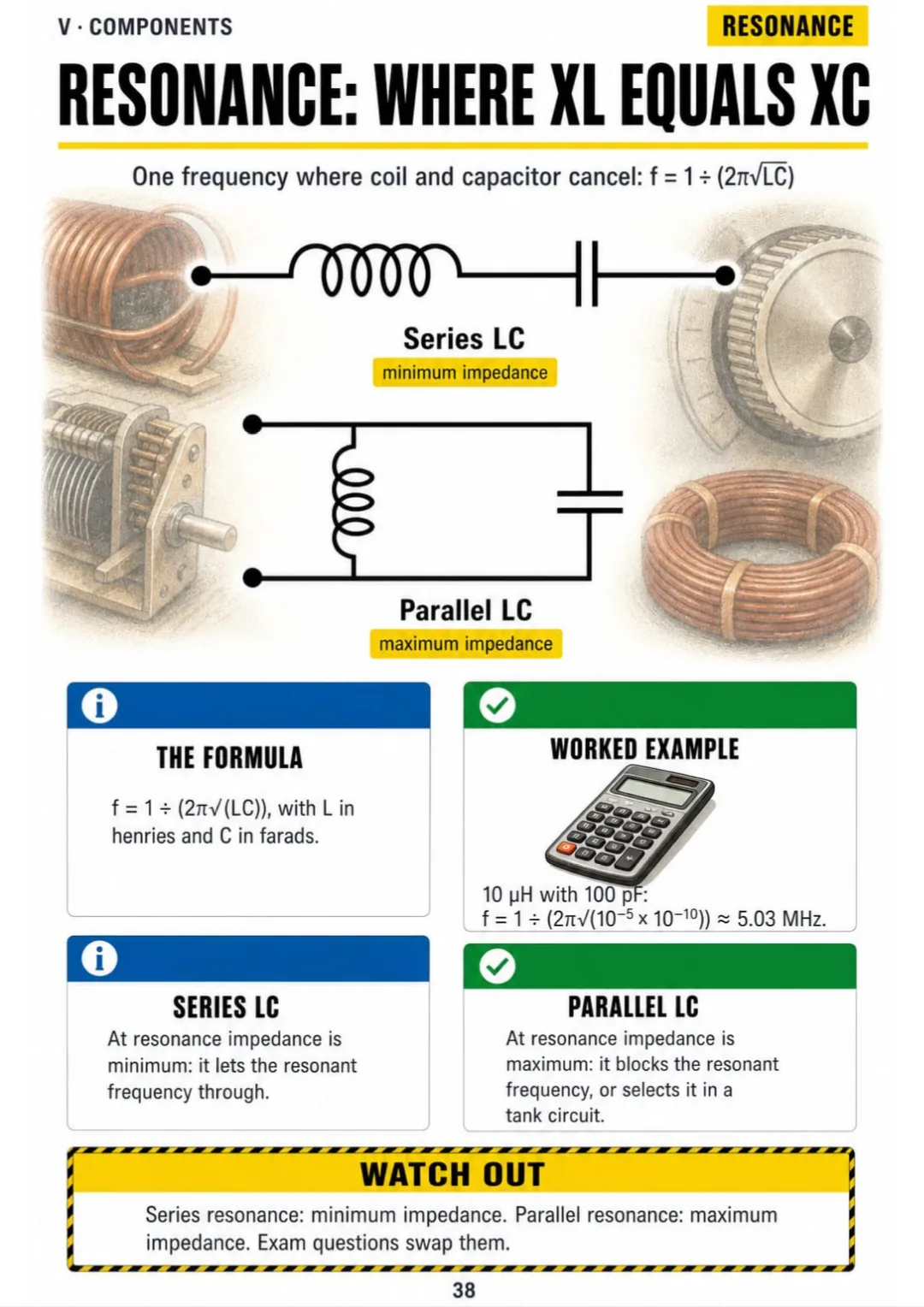
10 µH and 100 pF resonate at about 5.03 MHz
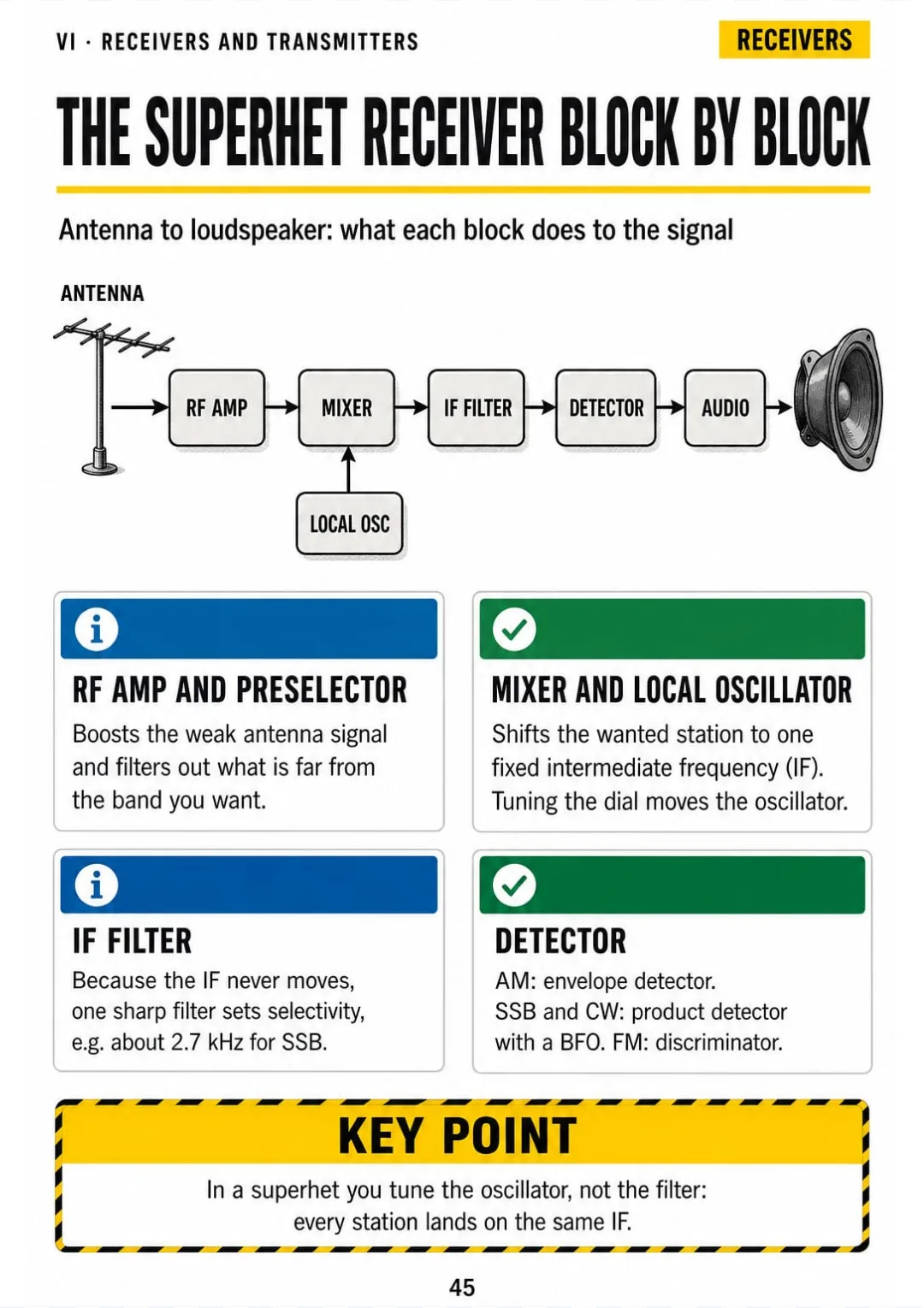
Antenna → RF amp → mixer + LO → IF filter → detector → audio.
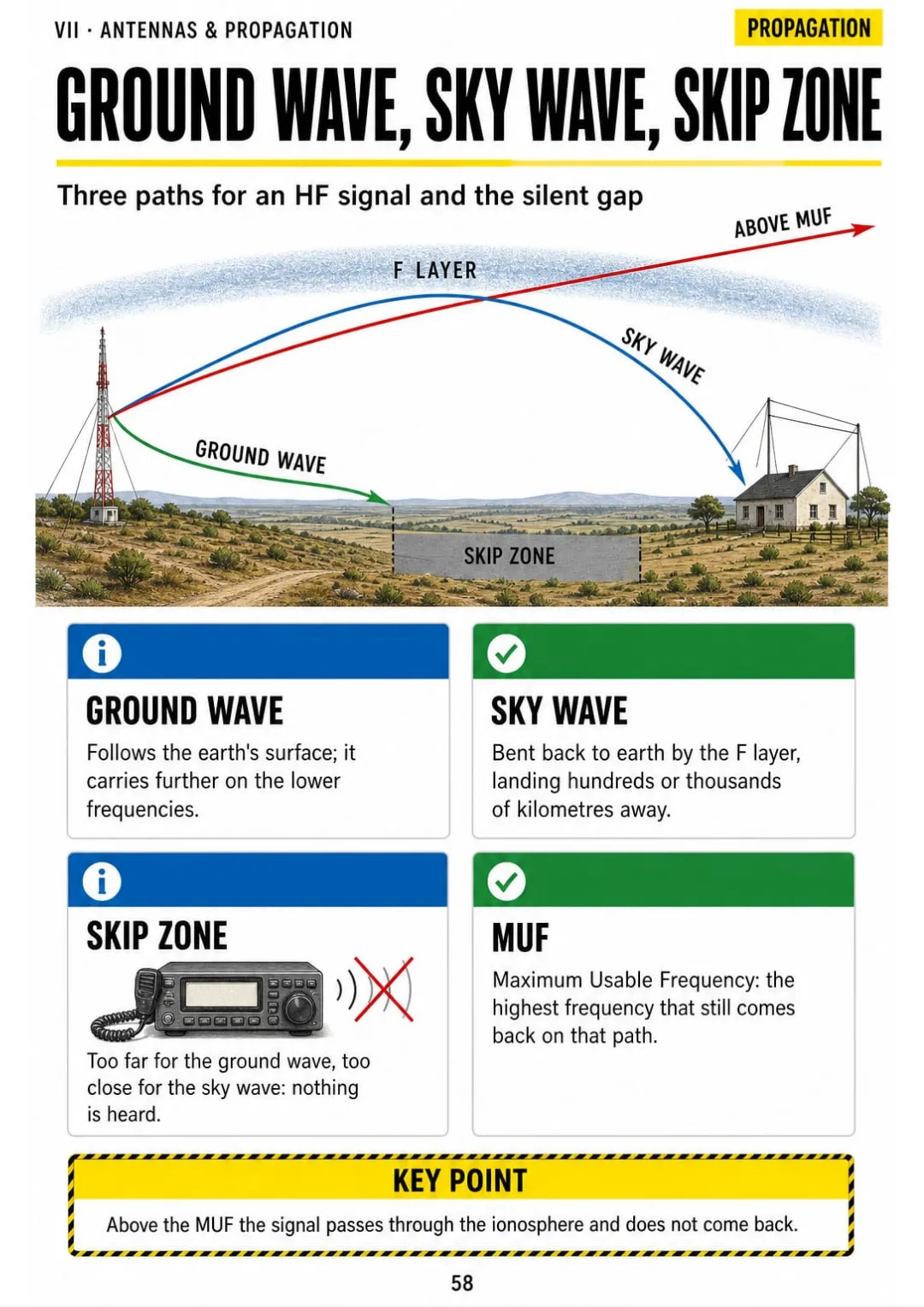
Ground wave hugs the earth, sky wave bounces off the F layer, the skip zone stays silent.
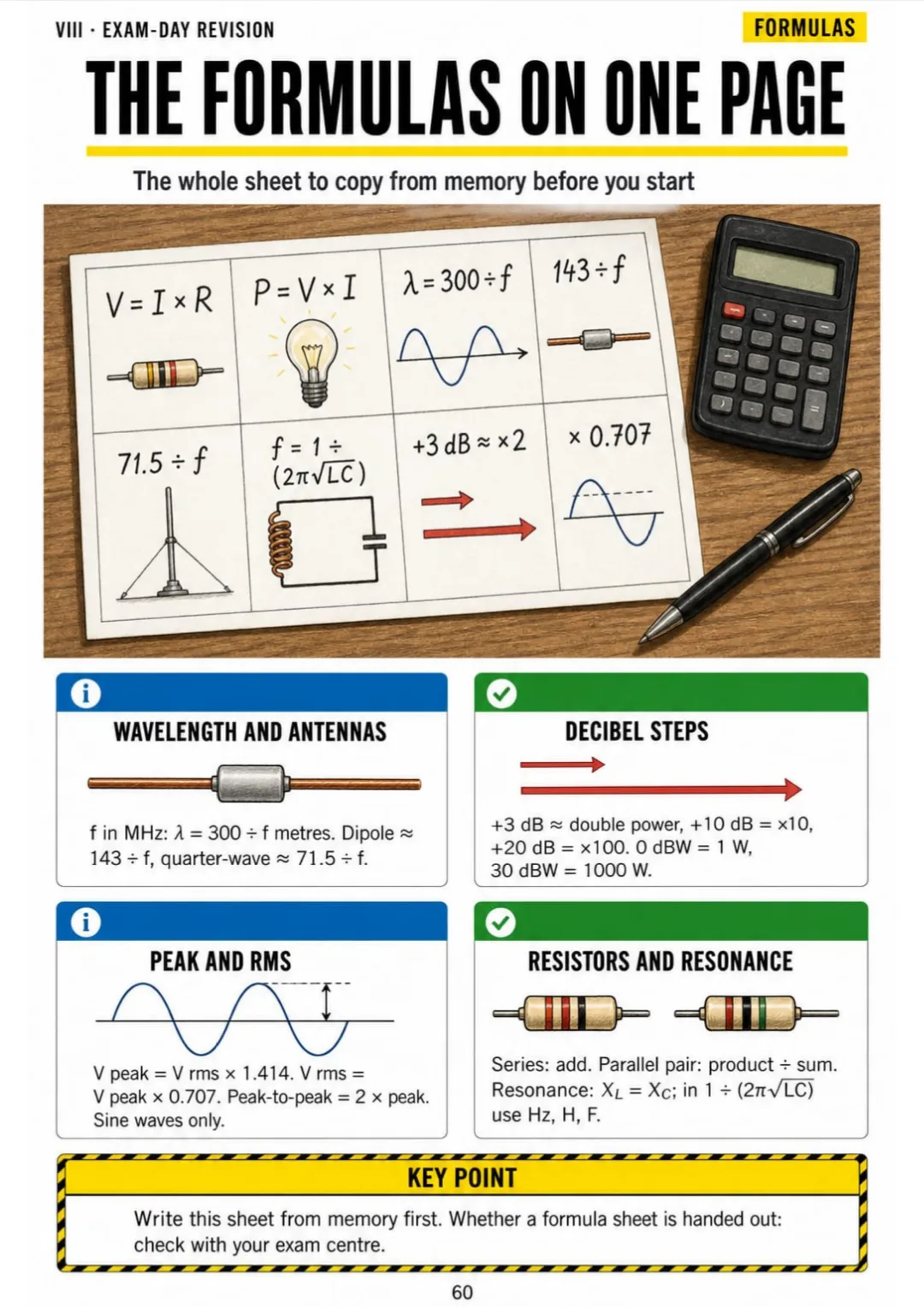
Ohm's law, 300 ÷ f, 143 ÷ f, 71.5 ÷ f, resonance, dB steps and 0.707 on one page
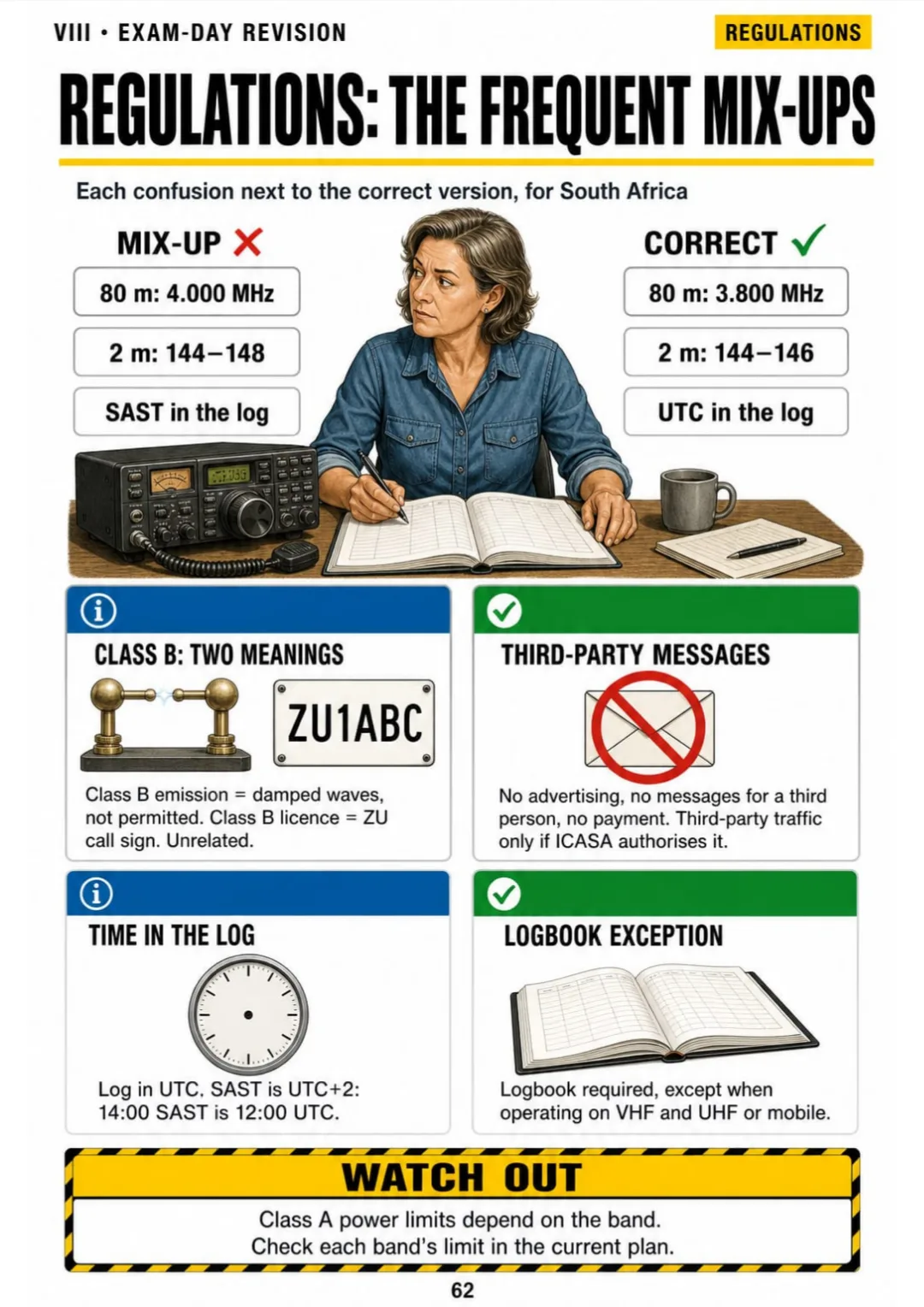
80 m ends at 3.800 MHz, 2 m is 144–146 MHz, and logs go in UTC

Swipe to see more →

These are real pages from the book. The table of contents is the full one: 8 parts and 61 topics.

The Problem Isn't You. It's How It Was Explained to You.

You're working through a practice paper and the question reads: a 10 W signal goes through 10 dB of gain. What comes out? You stare at it, and last night's decibels are gone.

It isn't for lack of trying. The manual explains decibels in three paragraphs of logarithms and ratios, with nothing to picture. So nothing is left by morning.

10 W + 10 dB = 100 W; 3 dB doubles, 6 dB quadruples.

In this book, decibels are one page: 10 W on the left, an arrow marked +10 dB, 100 W on the right. Underneath, three numbers in a box: 3 dB doubles, 6 dB quadruples, 10 dB multiplies by ten.

The same goes for Ohm's law with the triangle, resonance, the superhet receiver, the half-wave dipole and the skip zone. Each one has its own page and its own drawing.

You see the sum, you work it out and you move on to the next question. No going back to the manual to check.

COMPARE FOR YOURSELF

The Same Topic, Two Ways to Study It

THIS
  • The manual: line after line
  • Calling CQ explained only in words
  • You reach the practical assessment with doubts
Prior to the initiation of a general call, the operator shall ascertain by monitoring that the intended frequency is not already occupied by other stations, bearing in mind that a station may be audible to the distant party while remaining inaudible locally owing to propagation effects. An enquiry as to whether the frequency is in use should then be transmitted, followed, in the absence of any reply, by the general call comprising the CQ signal and the station's call sign, after which the operator shall again monitor for replies.
FOR THIS
  • Calling CQ in one drawing
  • The four steps in a box
  • Same order every time: listen, ask, call, listen again
Calling CQ: listen, ask if the frequency is in use, call, listen again
CONTENTS

Take a Look at the 8 Parts and 61 Topics

The licence and the exam, regulations, operating practice, electrical basics, components and circuits, receivers and transmitters, antennas and propagation, and exam-day revision: 65 pages, all illustrated

IThe Licence and the Exam · pp. 5-9
  1. From listener to licensed operator
  2. How the written exam is built
  3. What the practical assessment checks
  4. South African callsigns
  5. How to use this book
IIRegulations · pp. 10-18
  1. Who regulates amateur radio
  2. What an amateur may and may not do
  3. Identifying your station
  4. The South African band plan at a glance
  5. Power and modes for your class
  6. Third-party traffic and emergencies
  7. Logbook and records
  8. Interference and spurious emissions
  9. Operating abroad and reciprocal licences
IIIOperating Practice · pp. 19-26
  1. The phonetic alphabet
  2. Q-codes you will use
  3. The RST signal report
  4. Calling CQ step by step
  5. Answering a call and closing a contact
  6. Repeaters: offset and tone
  7. CW and procedure signals
  8. Station safety
IVElectrical Basics · pp. 27-35
  1. Voltage, current and resistance
  2. Ohm's law with the triangle
  3. Power: watts from volts and amps
  4. Resistors in series and parallel
  5. Prefixes without fear
  6. AC: frequency, period and peak
  7. Frequency and wavelength
  8. Decibels in three numbers
  9. Batteries and power supplies
VComponents and Circuits · pp. 36-43
  1. Capacitors
  2. Inductors
  3. Resonance and the tuned circuit
  4. Q and bandwidth
  5. Transformers
  6. Diodes and rectifiers
  7. Transistors as amplifiers and switches
  8. Filters: low-pass, high-pass, band-pass
VIReceivers and Transmitters · pp. 44-50
  1. Modulation: AM, FM and SSB
  2. The superhet receiver block by block
  3. Mixers and the image frequency
  4. Selectivity and sensitivity
  5. The transmitter block by block
  6. Oscillators and frequency stability
  7. Digital modes and computers in the shack
VIIAntennas, Feeders and Propagation · pp. 51-59
  1. The half-wave dipole
  2. The quarter-wave vertical
  3. Beams and gain in dBd and dBi
  4. Coax and ladder line
  5. SWR and matching
  6. Baluns and common-mode current
  7. The ionosphere: D, E and F layers
  8. Ground wave, sky wave and skip zone
  9. VHF/UHF line of sight and the sunspot cycle
VIIIExam-Day Revision · pp. 60-65
  1. The formulas on one page
  2. Ten sums worked from start to finish
  3. Regulations: the most frequent mix-ups
  4. Theory: the most frequent mistakes
  5. Practical assessment checklist
  6. The week before and the morning of the exam

One Page, One Topic, All Clear

Think of it this way:

It's your practical assessment. An experienced operator is listening, and you have to call CQ on a frequency you've never used before.

In the book, you open the page on calling CQ and see it drawn as four steps: listen, ask if the frequency is in use, call, listen again.

Antenna → RF amp → mixer + LO → IF filter → detector → audio.

The same goes for Ohm's law, decibels, resonance, the band plan and the skip zone: each one on its own page, with its own drawing.

Radio Amateur Exam Illustrated is 8 parts and 61 topics, all drawn, and it ends with the formulas on one page, ten worked sums and a practical assessment checklist.

What you see drawn, you don't have to memorize.

What's Inside Radio Amateur Exam Illustrated:

Ipp. 5-9

The Licence and the Exam

Going from listener to licensed operator, how the written exam is built, what the practical assessment checks, South African call signs and how to use the book.

IIpp. 10-18

Regulations

Who regulates amateur radio, what you may and may not do, identifying your station, the band plan, power and modes, third-party traffic, the logbook, interference and operating abroad.

IIIpp. 19-26

Operating Practice

The phonetic alphabet, Q-codes, the RST report, calling CQ, answering and closing a contact, repeaters, CW procedure signals and station safety.

IVpp. 27-35

Electrical Basics

The sums of the theory paper, each worked from a drawing: voltage, current and resistance, Ohm's law with the triangle, power, series and parallel, prefixes, AC, frequency and wavelength, decibels in three numbers, batteries and power supplies.

Vpp. 36-43

Components and Circuits

Capacitors, inductors, resonance and the tuned circuit, Q and bandwidth, transformers, diodes, transistors and filters.

VIpp. 44-50

Receivers and Transmitters

AM, FM and SSB, the superhet receiver, mixers and the image frequency, selectivity and sensitivity, the transmitter, oscillators and digital modes.

VIIpp. 51-59

Antennas, Feeders and Propagation

The half-wave dipole, the quarter-wave vertical, beams and gain, coax and ladder line, SWR and matching, baluns, the ionosphere, sky wave and skip zone, VHF/UHF and the sunspot cycle.

VIIIpp. 60-65

Exam-Day Revision

The formulas on one page, ten worked sums, the frequent mix-ups in regulations and theory, a practical assessment checklist, and the week before the exam.

At the end of the book: The formulas on one page, ten worked sums and a practical assessment checklist.
Plus: 2 Free Books

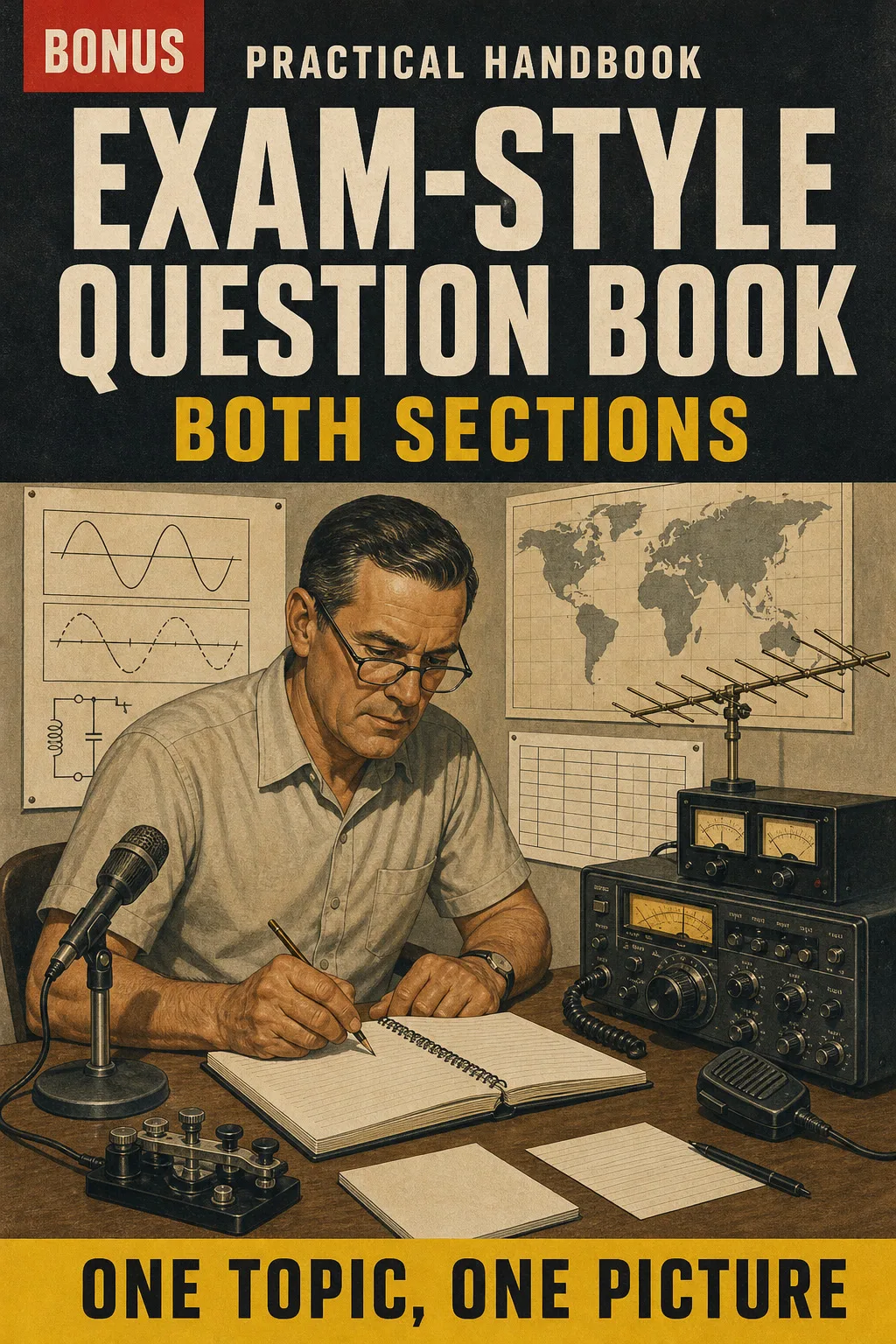
Exam-Style Question Book: Both Sections

BONUS 1: «Exam-Style Question Book: Both Sections»

Value on its own: US$ 17.90

Practise regulations and technical theory questions in exam style, with every answer explained on the same page, so you know which section still needs work.

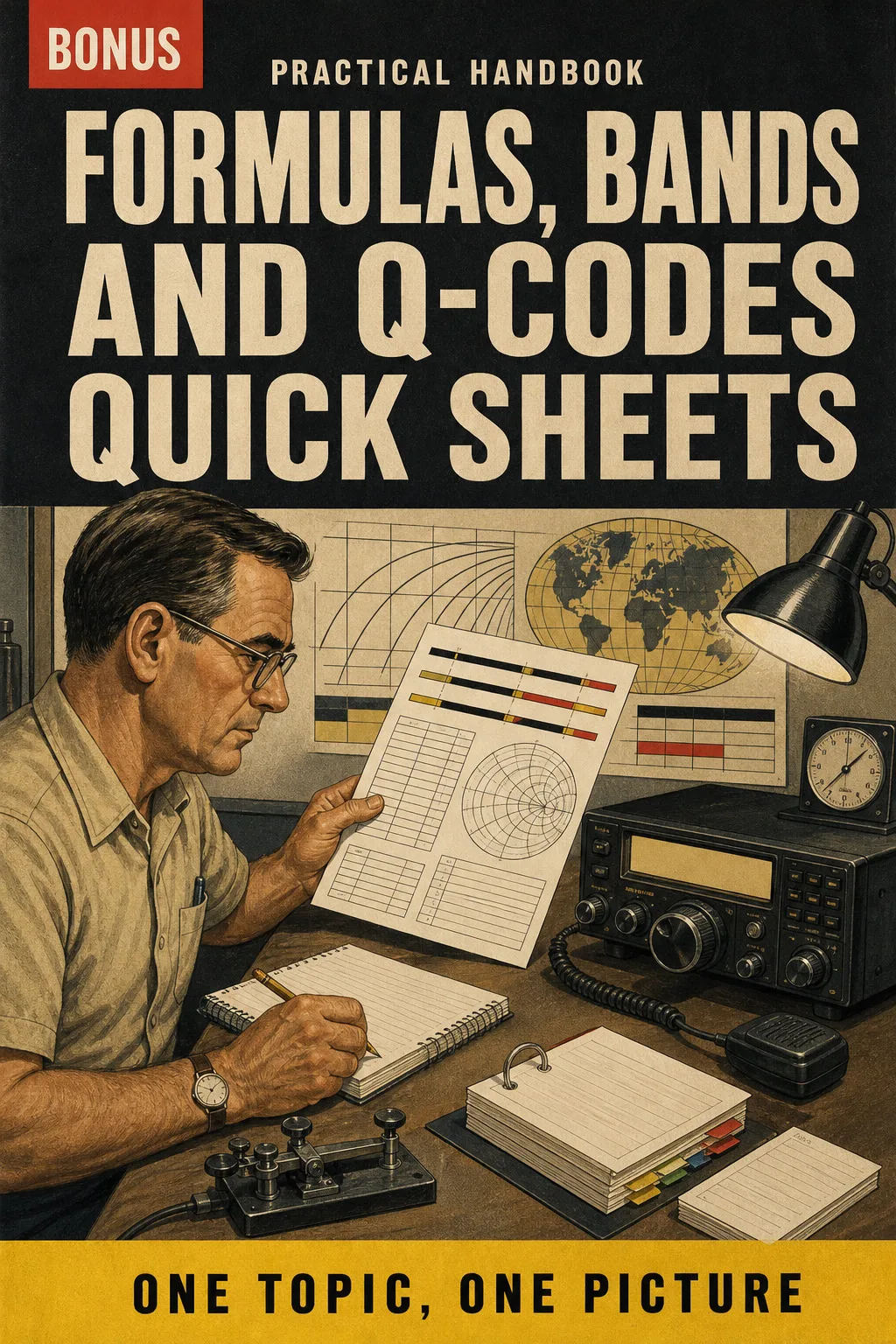
Formulas, Bands and Q-Codes Quick Sheets

BONUS 2: «Formulas, Bands and Q-Codes Quick Sheets»

Value on its own: US$ 14.90

Every formula, band, Q-code and procedure signal on a few printable sheets, to revise at a glance the week before the exam.

Radio Amateur Exam Illustrated with 2 Free Books

  • Radio Amateur Exam Illustrated: 65 illustrated pagesUS$ 63
  • BONUS 1: Exam-Style Question Book: Both SectionsUS$ 17.90
  • BONUS 2: Formulas, Bands and Q-Codes Quick SheetsUS$ 14.90
  • High-resolution PDF to printIncluded
Total value US$ 95.80
YOUR PRICE:
US$ 27
You save US$ 68.80
YES, I WANT RADIO AMATEUR EXAM ILLUSTRATED FOR US$ 27

📄 This is a digital PDF book sent to your email: nothing is printed or shipped.

Secure purchaseEncrypted payment30-day guarantee

PDF by email: We email you Radio Amateur Exam Illustrated as a PDF, together with the two free books. It's a single payment: no installments, no extra charges.

Who This Book Is For

You're studying for Class A

You're studying for Class A

Each rule and each sum sits on its own page with a drawing, so what you study in the evening is still there in the morning.

The exam session is close

The exam session is close

The formulas on one page, ten worked sums and the frequent mix-ups to revise in the last week, plus a checklist for the practical assessment.

You're already on the air

You're already on the air

The band plan, the Q-codes and calling CQ, printed and kept in the shack to check at a glance before a contact.

Everything You Get Today

US$ 95.80US$ 27
YES, I WANT RADIO AMATEUR EXAM ILLUSTRATED FOR US$ 27

📄 This is a digital PDF book sent to your email: nothing is printed or shipped.

30DAYS
GUARANTEE

30-Day Guarantee

Try Radio Amateur Exam Illustrated for 30 days, bonus books included.

We refund everything if the file won't open, if the book isn't what you see here, if you were charged twice or if the email doesn't arrive. Just email us.

You pay once. No subscriptions.

Frequently Asked Questions

Is it for me if I haven't done a sum in thirty years?

Yes. No logarithms to memorise: decibels come down to three numbers. Every calculation is worked through step by step in metric units, from Ohm's law to antenna lengths in metres, always in the same order: what it is, the drawing, the formula, an example.

Where does the content come from?

From the current Radio Amateur Examination syllabus used in South Africa, the ICASA radio regulations and amateur licence conditions, and the South African band plan (ITU Region 1). It isn't a US book: no FCC rules, no US band plan, metric units and South African call signs. Band limits and licence conditions can change, so before you transmit, check them against the current ICASA documents.

Is it official material?

No. It's an independent illustrated study aid. It isn't affiliated with, approved by or endorsed by ICASA, the South African Radio League or any exam body.

Does it replace a course or club training?

No. It's a study and revision aid to use alongside the official syllabus, a course or your club's training. It doesn't give you a certificate or a licence: your call sign comes from passing the exam and the practical assessment.

Are the practice questions the ones from the exam?

No. They're written for this book in exam style, to practise both sections. They aren't official exam questions.

When and how does it arrive?

As a PDF by email, to the address you enter at checkout. The 2 bonus books come the same way.

Do I have to pay every month?

No. It's a one-off payment.

Can I have it on paper?

Yes. It's a printable PDF: print it at home or at a print shop and keep it in the shack.

How does the refund work?

You have 30 days. We refund everything if the file won't open, if the book isn't what you see on this page, if you were charged twice or if the email doesn't arrive: just email us.

Before You Close This Page

No more rereading with nothing left by morning.

Decibels, resonance and the skip zone: you see them drawn and that's it.

You walk into the exam knowing where everything is.

Drawings make studying faster.

The book is right below.

One-time payment: US$ 27 · Guarantee: 30 days · PDF by email

YES, I WANT RADIO AMATEUR EXAM ILLUSTRATED FOR US$ 27

📄 This is a digital PDF book sent to your email: nothing is printed or shipped.